Siteory alternative: HubSEO vs Siteory compared
Siteory and HubSEO both audit a live site and turn each finding into a fix prompt for Claude Code, Cursor or Codex. Siteory adds a security audit, a multi-page crawl and an MCP server; HubSEO adds mobile and desktop Lighthouse lab runs, Core Web Vitals evidence and re-checks with Fix Pack or Pro. Compared as of 9 November 2026.
What each audit measures
Siteory crawls a site and reports four groups. SEO: titles, descriptions and headings, canonicals and canonical chains, robots.txt and sitemap coverage, broken links, orphans and crawl depth. AI visibility: llms.txt and llms-full.txt, JSON-LD and Organization identity, AI crawler rules in robots.txt, thin copy on key pages. Security, on full audits only: HSTS, CSP and frame protection, referrer and permissions policies, CORS rules and exposed admin paths, and internet exposure data from Shodan. Foundations: status codes, redirects, HTTPS and time to first byte per page. Its published check list does not include Lighthouse lab runs or Core Web Vitals.
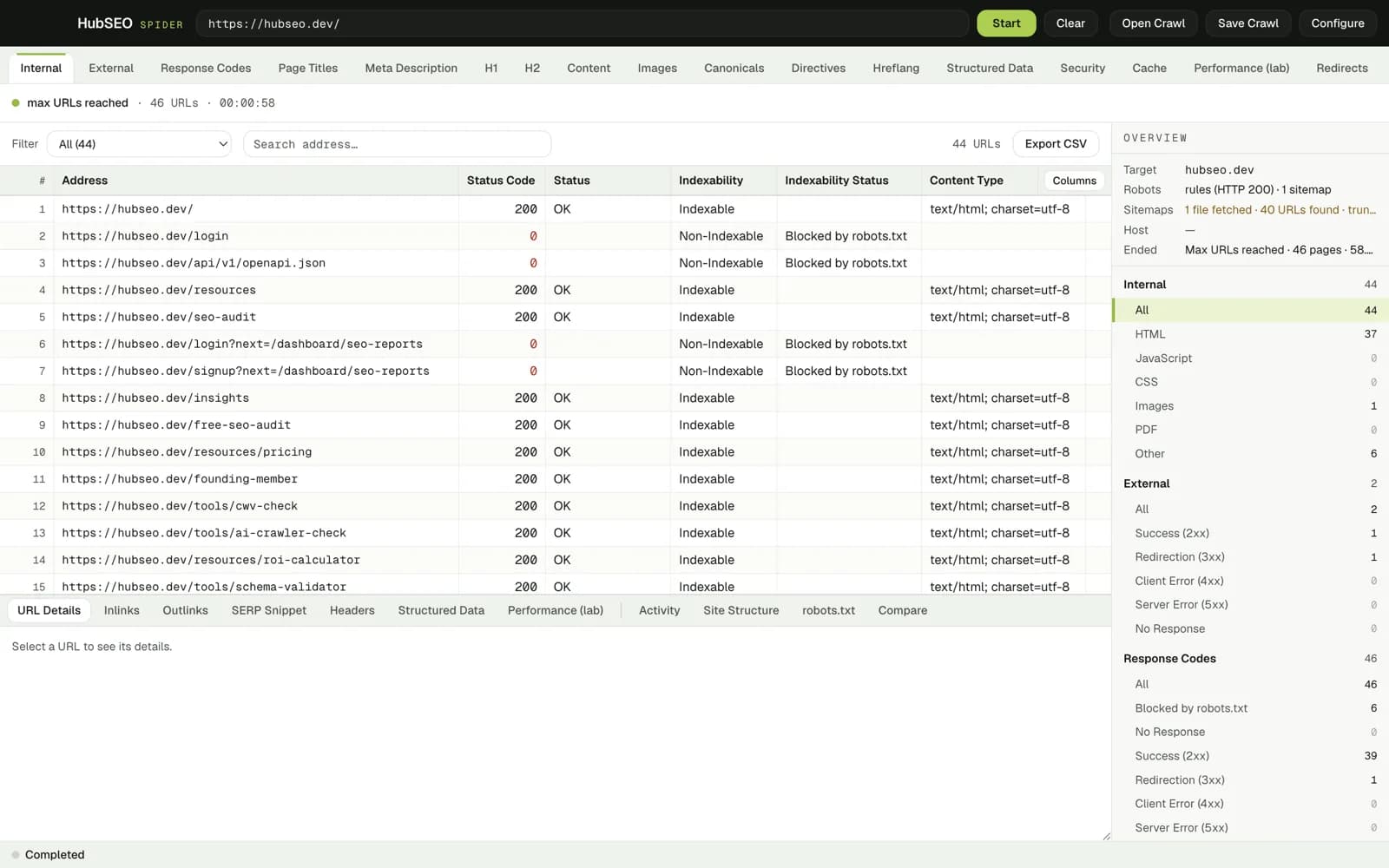
HubSEO audits one URL at a time in mobile and desktop contexts: Lighthouse lab metrics (LCP, CLS and TTFB), Core Web Vitals field evidence including INP when CrUX data is available, HTML evidence, security headers, crawlability (robots.txt, sitemap.xml, redirects), on-page signals and an experimental AI-readiness check. Every finding carries the measurement that triggered it, and the top fix arrives as one prompt scoped to one finding.
| Siteory | HubSEO | |
|---|---|---|
| One audit covers | A crawl of the site; the sample report caps at 25 pages | One URL, tested on mobile and desktop |
| Performance evidence | Time to first byte per page | Lighthouse lab runs with LCP, CLS, INP and TTFB |
| Security | HSTS, CSP, CORS, exposed paths, Shodan exposure (full audit) | Security headers on the audited URL |
| AI visibility | llms.txt, JSON-LD identity, crawler rules, thin copy | Crawler rules for GPTBot, ClaudeBot and Perplexity; experimental AI-readiness |
| Agent handoff | Fix prompts for Claude, Codex, Cursor and OpenCode; MCP server and ten skills on paid plans | One prompt per finding for Cursor, Claude Code, Copilot and Codex; REST API |
| Re-check after a fix | Re-scan and compare audits | Re-check with Fix Pack or Pro |
| Without an account | Preview: score and the top three issues | Full ranked check and the top fix prompt |
| Installed on your site | Nothing | Nothing |
Where Siteory is the better pick
Pick Siteory when the job is wider than one page.
- 1It crawls many pages per audit, so orphans, crawl depth and canonical chains across the site show up in one report.
- 2Its security audit goes further than headers: CSP strength, CORS rules, exposed admin paths and Shodan exposure data, on paid audits.
- 3Its MCP server and agent skills let Claude Code, Cursor or Codex run the scan, fix the findings and re-scan without leaving the editor, on the Single or Pro plan.
- 4A single paid audit costs $9, against £39 for a HubSEO Full Fix Pack on one URL.
Where HubSEO is the better pick
Pick HubSEO when you need lab performance evidence and a free loop.
- 1Lighthouse lab runs on mobile and desktop with Core Web Vitals, which Siteory's published checks do not cover.
- 2The full ranked check and the top fix prompt without an account; Siteory's no-account preview shows a score and the top three issues.
- 3A free re-check with a free account, so you can see whether the issue is still flagged after your agent ships the change.
- 4Scheduled audits on Pro (£59 a month, four a month) and Business (£129 a month, twenty a month), plus a £299 one-time lifetime option.
- 5A REST API with API keys, documented at hubseo.dev/docs/api, for teams that script their checks.
Prices, as of 9 November 2026
Siteory: Free, $0, a preview without an account and one full audit with a verified account. Single, $9 one-time, one full audit. Pro, $49 a month, ten full audits a month. The MCP server, agent skills and local checker need Single or Pro. Prices are shown in dollars on siteory.co.
HubSEO: free for one audit per rolling 30 days without an account and three per month with a free account. Full Fix Pack £39 one-time for one URL. Pro £59 a month. Business £129 a month. Founding Member £299 one-time, lifetime while the offer is open.
Siteory facts come from siteory.co, read on 9 November 2026. HubSEO facts come from hubseo.dev/resources/pricing and the audit page on the same day. Siteory is built by Vishal; HubSEO is not affiliated with it.
Frequently Asked Questions
Is Siteory free?
Siteory's preview is free without an account and shows a score and the top three issues. One full audit is free with a verified account. After that, audits cost $9 each or $49 a month for ten, as listed on siteory.co on 9 November 2026.
Does HubSEO have an MCP server like Siteory?
No. HubSEO exposes a REST API with API keys, documented at hubseo.dev/docs/api, and hands each fix over as a copy-paste prompt. Siteory offers an MCP server and agent skills on its paid plans.
Which one measures Core Web Vitals?
HubSEO runs Lighthouse lab tests on mobile and desktop and reports LCP, CLS, INP and TTFB with the evidence behind each. Siteory's published checks cover time to first byte per page but not Lighthouse or Core Web Vitals, as listed on siteory.co on 9 November 2026.
Can I use both?
Yes. Siteory's multi-page crawl and security audit and HubSEO's per-URL lab evidence overlap little, and neither installs anything on your site or asks for CMS or hosting credentials.
Audit your site live: get verifiable AI-ready fix prompts
Run a headless Chromium crawl to measure real Core Web Vitals, discover indexation barriers, and generate code fixes formatted directly for Claude Code and Cursor.